

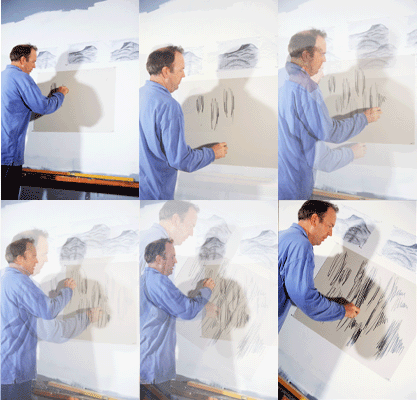

Brereton working on one of the Messiaen at Mt Kiera drawings, 2001
Please click on each image and move to left or right while holding down mouse

Nuemes, 80cm x 300cm oil and graphite on paper, 2001
Mode of Durations and Intensities (After Messiaen)
A series of drawings in lead pencil, conte crayon and oil paint are used as baseline media for the digital construction of an animation work. The animations were exhibited in conjunction with the drawings.
This series was inspired by the music of the French composure Olivier Messiaen (1908-1992). In particular, the Four Rhythmic Studies series. The track chosen was the Modes of Durations and Intensities.
The Modes of Durations and Intensities initiated the use of total serialism. The piece is constructed of three sets of pitches which are not treated in any predetermined order but are differentiated by the other determined elements – durations.
The drawing technique seeks to find a graphic analogue for the sonic notes and intervals, resonances and intensities. In order to build up a graphic rhythm of marks, gradations of tone (black to white) and colour (greens) act as a counter score to the individual notes. The allusion to wave representations in computer software verses traditional sheet music notation, is consciously played with.

Modes - drawing in early stages
go to ABC Radio National EarClips to listen to Lyrebird Mixdown sound work at
http://www.abc.net.au/rn/arts/earclips/03.htm

Meeting Messiaen - A Tribute to French Composer Olivier Messiaen (SFMOMA) 2002
This 2002 tribute went far beyond the borders of contemporary classical music and highlighted the influence Messiaen still has on today's artistic life. From fields as diverse as computer music (Subotnick, Wessel), jazz (Zorn), and the visual arts (Brereton), artists will present Messiaen's world and personality through their own work. The new opera production was evoked by the performance of short excerpt from Saint Francois d'Assise.
These cross-disciplinary bridges were highlighted by practical and didactic means. Kurt Brereton evoked Messiaen's insatiable quest for birdsongs as well as synesthesia and the essential part musical colors would play in Messiaen's composition, through his paintings and installations. In informal discussions, computer music pioneer Morton Subotnick and eclectic composer John Zorn shared their interest in Messiaen's work. Scientist and improvising composer David Wessel gave a hands-on tutorial on the Ondes Martenot, a rare instrument that is key to Messiaen's Saint Francois d'Assise.
Live performances included excerpts of the 3rd scene of Messiaen's Saint Francois d'Assise, Morton Subotnick's Gestures..., and John Zorn's Duras, a composition inspired by Messiaen's Quatuor for the end of time.
Messiaen: Sound to Image
Catalog essay by Stephen Ingham
Picture this: the elderly man negotiates the unfamiliar terrain of the Illawarra escarpment in search, not of views (though these are quite spectacular) but of sounds.
He has been doing this all his adult life. Initially reliant on his hypersensitive hearing and notational skills (for he is a composer in the grand European tradition) he later realised the necessity of specialist study. These are not just any environmental sounds. They are unique to geographical location and natural habitat, and their inclusion (or at least representation) in his musical works have made these, too, unique in the canon of classical music.
Olivier Messiaen was born in 1908 and grew up in Grenoble, the French alpine city of gloves and hydroelectric power. “A city”, Fiona Sampson tells us1 “of chemists and engineers, nineteenth century rationalism and salutary views”. His father taught English, his mother wrote poetry. But for an early encounter with the music of Debussy, Olivier, too, might well have focussed his prodigious creative gifts on the realm of literature. Then again, such was obsession with those special sounds, his legacy might equally well have been in the field of ornithology.
Birdsong first makes its appearance in an early orchestral piece, L’Ascension in the 1930’s. Here, a melodic line mimics the superficial characteristics of a generic “birdsong style”. By the 1950’s, however, the years of research and painstaking field-trips to collect and specifically identify the sounds of different species results in music which is frequently pure birdsong – a complex counterpoint in which the orchestra represents choruses of birds, in particular the dawn chorus.
It was one special bird, however, which drew him in his eightieth year to the sunlit eucalypt glade. The superb lyrebird obliged with a display and a stream of song cascading through the forest, all faithfully rendered into musical notation and later reproduced in the third movement of his last great work, the Eclairs sur l’au-dela.
The British musicologist Paul Griffiths sees the various Australian birdsongs which suffuse the score as “souvenirs of the composer’s eightieth birthday tour … though at the same time the southern-hemisphere birds are emblems of another world”2. His equation of the lyrebird’s leaping motif and plumage display as the “Heavenly City’s dressing of herself for espousal to Christ”, connects with Messiaen’s other great pre-occupation, the Catholic faith.
What makes Messiaen's vision so unique, colourful, and compelling (I am reminded of William Blake) is that nature, man, and the divine do not inhabit separate spheres in his musical universe, but, rather, blend together in a glorious and kaleidoscopic harmony.
Kurt Brereton’s own response to this vision (“Messiaen at Mt Keira”) can be neatly summarised as “from the sublime to the pathetic”. Brereton’s objective in this sequence of images (with digitally animated CD-ROM and audio composition) seems to be to re-trace the composer’s footsteps quite literally, and to interpret the landscape scene and its lyrebird protagonist from a fundamentally different cultural perspective.
Brereton’s lyrebird is “a great mimic … a pathetic (and perhaps prophetic) town-crier” signalling the fragility of the escarpment’s ecosystem. The first set of images (“Ambiences de Mt Kiera”) superimpose the lyrebird’s call, rendered as if an audio waveform, over the massive silhouette of the mountain, at once obliterative and threatening. The limited tonal palette recalls the sparse texture of Messiaen’s more monumental scores (Des canyons aux étoiles, Couleurs de la cité celeste), while the intrusive monoliths convey the block-like musical architecture. Fiona Sampson again: “Blunt, monumental chords pile up from its basso profundo logic. Without knowing that we recognise the rhythm, we realise we too have started to dance to the music of time”3.
In the works “Mode de Valeurs et d’Intensités”, “Ile de Feu (I & II)” and “Neumes Rythmiques”, Brereton revisits the sequence of solo piano works Messiaen composed in 1949 and 1950 under the collective title Quatre études de rythme. These were works which were nothing short of inspirational for the young central European avant-garde (Stockhausen, Boulez, Nono) who gathered in the ruined city of Darmstadt after the war to rebuild the language of new music. Brereton here meditates on the unlikely mix of numerological sequences, startlingly novel sound constellations, and invocation of the “mysterious East” (Ile de Feu is dedicated not to a person but to a country, Papua New Guinea).
With the final set of images (L’oiseau-lyre et la Ville-Fiancée), the lyrebird at last appears explicitly, at times playful, sometimes whimsical, and with its plumage even transmogrified into a semblance of Arabic script. For Messiaen, the lyrebird represented a source of “pure” music, undefiled by the modern world. For Brereton, this connection is not nearly so clear. In the soundtrack of the CD-ROM, the bird’s song mimics the destructive power of the chain saw, heralding a future far less certain than that promised by the metaphysical system to which the composer was a lifetime adherent.
© Stephen Ingham, 2001
Associate Professor
Creative Arts
University of Wollongong
References
1) and 3) “Home is where One Starts From”, Fiona Sampson, Heat 14
2) “Eclairs sur l’au-dela – the last works”, Paul Griffiths, in The Messiaen Companion, Faber 1995
Artist Statement (Kurt Brereton)
Time is coloured and shaped by our imagination. Sublime music such as Messiaen’s occupies a stage where time seems to stand still – a frozen present where we compose ourselves.
Each of The Four Rhythmic Studies Series may be read as a typographic score. Such literal translations (simple equivalences) of Messiaen’s music into visual forms belie the power of the imagination. Each panel may also enter the imagination as a pathological slide (a heterographic still); an episodic slice of layered time ranging from a few seconds to a few minutes.
Whenever he heard a bird’s song, Messiaen saw abstract colours (signs) that were animated in his minds eye. Chords were streams of notes that only gained their full haptic meaning when mentally aggregated with colours or graphic tones. We are all synaesthetes to a greater or lessor extent yet we persist in separating the sensorial disciplines along canonical media lines. My aim is to create an immersive graphic space or field where Messiaen’s music can be expanded along interactive lines.
The Messiaen at Mt Kiera series focuses on the lyrebird as an emblematic and prophetic voice in the rainforest escarpment that forms a sublime backdrop to the rampantly urbanising Illawarra coast. Lyrebirds are mimics (bardic commentators) who record and playback both the disappearing songs of the forest and encroaching cultural signs of their own destruction. This shy brown ground-scratcher is also a superb “queen of the forest” style multimedia artist. Taking to the stage it boasts the loudest call of any forest bird. It’s lyre-shaped tail feathers quiver violently in a transfixing audio-visual performance that can suffer encore after encore.
The lyrebird writes to memory its repertoire of songs, calls and sound effects in a specific running order. Nature comes before culture, yet in time cultural signs morph into naturalised symbols. Reports circulate of lyrebirds passing down to succeeding generations the long silent samples of pre-colonial Aboriginal corroborees or century-old flute melodies. Such Homeric oral phrases recall the uncanny nature of Antipodean logic.
Hermes, the Greek God of music and prophecy, was also the patron of tricksters and thieves. Hermes invented the lyre (and the musical scale) from the shell of a tortoise (water’s song) and the horns of a cow (heraldic meeting of earth, air and fire). The Lyrebird also performs Erato, the lyre-strumming muse of love poetry and mimicry. This is a melancholic (pathetic) performance on loss (Narcissus calling in vain to Echo) and elusive reflections (the gaze dumbly returned) of sublime visions always just out of reach. The Illawarra escarpment is also an Orphic world – the whole forest stops to listen to the lyrebird as he eternally replays the moment of his tragic loss; and we, in turn, catch glimpses of Euridice’s dissolving presence in the shadows of the Flame Tree, Straggler Fig and Cabbage Tree Palm.
In recalling the song of the Lyrebird, we replay the presence of our own existence, in time, place and “country”.
© Kurt Brereton, 2001

Isle de Feu II, 80cm x 300cm oil and graphite on paper, 2001
Kurt Brereton at The Loft
Opening Speech
Loft Gallery, UTS, Sydney
by George Alexander, 2001
In all the vast deadly tracts of poststructuralism, one of the central concepts of the last twenty years that made any enduring sense for me –- was the redefinition of desire by Deleuze/Guattari. Desire as Production.
It knocked off Jacques Lacan’s stuck-up idea of Desire as Lack. You know? Because of some original trauma, some burst blister, you played out endlessly your lack, manqué, bayance. Desire full of all kinds of neurotic hesitations and bloody hopeless yearnings. It was needy.
For Deleuze desire lacked nothing, desire was productive. It was a way out of the defensive cul de sac; it was neon-lit, pragmatic philosophy that wore studs & neck bandanas. It was desire with tail fins. It was an uptempo, art-friendly device that brought everything nearer, by not keeping still.
Now Kurt Brereton was someone who unashamedly embodied desire that lacked nothing, desire as production. He took to it like a duck to orange sauce. How come? Part of it was sheer chutzpah, but a lot had to do with his upbringing.
Did you know Kurt Brereton was born in a circus and ran away to live in a home?
Both parents were artists, first generation hippie drop-outs before there were hippies, bohemian Beat artists from Melbourne who could weave, throw pots, paint, make baskets and fishtraps and stuff. They pitched their tent in the coastal village of New Brighton near Mullumbimby. A Mullumbimby before Japanese cars, shopping malls & Do the Right Thing garbage cans.
It’s an important influence. To know about Kurt’s work, it’s important to know about this semi-tropical flavour of consciousness. Those rapturous latitudes where Time drowns under the Kodak-orange sun, and among the honeycombed galleries of mangrove and pandanus; where the local cannabis sattiva is called ‘Madness’. Melaleucas, snowwhite beaches, driftwood, bleached seashells, a billion crashing waves, and a sun like buttered toast. That’s where Kurt learnt his vernacular craft and the kind of chortle of child-like well being we hear to this day.
And, it comes with a very respectable visual tradition that Kurt was nourished by: the dappled, weather-beaten, lime-green-and-olive Pacific beaches of Ian Fairweather (a friend of Kurt’s mother Janet), and the tropical palm-fringed surfaces of Ray Crooke. It’s a palette and a sensibility he keeps coming back to.
His sister Sal once told me that as a boy he showed a lot of promise: he was so talented he could cut a boat out of a pinecone with a breadknife, and still have a few fingers left.
So this exhibition is partly about how this one-man heathen horde became an interactive multimedia installation artist. Partly it has to do with being unable to devote his time to just one thing. Partly to do with technology catching up and putting it all together in what they call media convergence.
No matter what he’s doing, Kurt likes to stir things up like a Thai chef with a wok. So it was natural for him to hang his fiction in a gallery, and play his theory on the Hawaiian guitar. I’d not be at all surprised if he told me he was making CD-Roms with shrimp paste, chilli sauce, and galangal powder.
When I first met Kurt in 1978/9. We were both living in a rundown block of flats full of artists, poets and cartoonists in Glebe, Sydney. Yes he was this bob-tailed, hyphenated thing: he performed (for Pippi Storm), did magic tricks (he learnt magic from an old pro The Amazing Mr Rooklyn, the world famous exponent of spherical sorcery and brother of pokie crime boss Jack Rooklyn. Once, in 1984, at Jameson St Cabaret, during a Futur*Fall event, dressed in Captain Cook gear and on roller skates, we disappeared a duck together in front of a very bewildered Jean Baudrillard.
Can he eat fire, juggle a chainsaw, banana and a copy of Flash Art while riding a unicycle? I dunno!
I know he surfed, he painted, he drew, took photos and put together a brace of postcards under the name “John Dory” as well as being editor of the ground breaking book Photo-discourse. He could also write jubilantly and his poems in Otis Rush and Heat magazine are proof positive and worth a close read. In 1978 shot a doco called Chuck You Farley, on Sydney punk scene and it’s still maturing under his bed.
He’s also a great collaborator, and you can always be sure he’ll give 150%. Never petulant, he’s as breezy as Dean Martin in a crisis.
He even got into academia as a way to make a quid. I for one didn’t think he could do it or should do it. This is just me but I thought it was as unnatural as pushing a peanut along Broadway with his nose. It took too much ditch-digging energy, a lot of running up and down the stairs of Theory. Looking at him you’d think he was too light for heavy work, too heavy for light work, and too sexy for night work….but NO for someone so laidback, his work ethic is impressive. (1)
But it brought him shelter for the winter, put food on the table and added a little quality to his act.
Unrealistically I wished he’d just keep making those gorgeous Super 8* films because I dug them so much. – so fast, so slow, so lyrical: they were epiphanies, not mere novelties.
And Brereton could live it up! I know, I lived with him for a while in the early 1980s on a rooftop flat above Bondi Beach: the action was drugs, sex, bongo jams, roller skating and art making: the ultimate you-hadda-be-there, that seems more fun as the years go by.
Kurt could also pun like a crazy man. Another reason we got on so well. Puns happen where meaning and laughter blend. He could pun like a kid with a mouth full of Mars Bars. Or “Picnics” which became prickstrips, titlicks, nipsicks, gripwicks, slipthicks, liptricks and so on.
Now of course bloody Time has given us all a bit of a hiding. The wild bad boys are now as domestic as slippers. Kurt’s now got a couple of ankle biters down at Bulli Beach north of Wollongong. And we’re both starting to look like old potatoes. (2)
Desire as Production.
This show gives you an idea of the criss-cross energies, I’ve been talking about – punning across materials and mediums: paintings, drawings, collages, animations and audios put in the mix.
This exhibition dissolves what is worldly about him into the frizzed resonance bars of Messiaen – and the Lyre birds of Mt Kiera – and then all this transcendental metaphysics comes crashing back to earth with the sampled sounds of chainsaws.
So: cosmic perspectives and self-deflating colloquial responses, laughter mixed with awe, and lots of great work to look at.
So without standing in the light of the exhibition, let me here formally light the blue paper, pop the corks, wish the bride and groom – and all who sail in her – the very best.
©George Alexander
Co-ordinator of Contemporary Programs
The New South Wales Art Gallery, Sydney.
October 2001
Footnotes
1. Kurt is now an Adjunct Professor at UTS and works on-line out of his Bulli studio.
2. “Speak for the self!” Kurt said.