

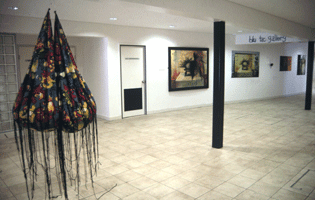
Pathetic Manifesto Series, Blu Tac Gallery,
Faculty of Creative Arts, Wollongong, 2000


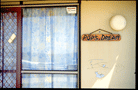

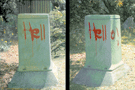
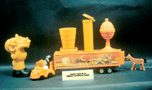
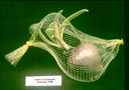

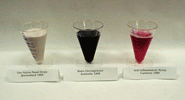
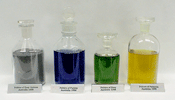
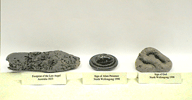
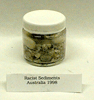
Pathetic Pathologies of Australia
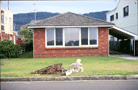

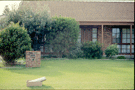
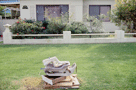

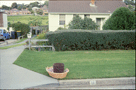
The Chuckout Series, Bulli, Australia, 1998

Happy Birthday Cakeboy, 2001
Pathetic Manifesto Series
(1997 - )
Overview
The pathetic manifesto project is an ongoing series of involving performances, art exhibitions and lectures. During 1999 and 2000 the University of Wollongong, Australia was the centre of attention. The following manifesto provides an overview (in no particular order) of some of the discursive findings of this project to date.
An artist's talk was delivered at Project Gallery in Wollongong titled: "Patheticism- A report from the Illawarra frontline."
July 28th 2006 7pm to an audience of 3 people. No questions and no discussion took place. Everyone left early......

Rumour is that this book is being published if the author can get his act together and ring his hot shot drug-fucked "a monkey with no nuts could do your job" agent in LA ....
Definition of Patheticism
Connected to Pathos (from paschein, the Greek word meaning "to suffer" or "emotion") is one of the three modes of persuasion in rhetoric (along with ethos and logos). In rhetoric, pathos is the use of emotional appeals to alter the audience's judgement. A common use of pathos in argument is creating a sense of rejection if the audience doesn't agree. Creating a fear of rejection is in essence, creating a pathos argument.
Empathy is often characterized as the ability to "put oneself into another's shoes", or experiencing the outlook or emotions of another being within oneself, a sort of emotional resonance.
Patheticism -
• attempts to synthesize disparate accounts of pathos and the pathetic.
• indicates a desire to move beyond the bounds of irony via an unapologetic occupancy of a position which is from the outset acknowledged to be untenable in any heroic sense yet very human.
•ethos of empathy, the democracy of failure, and any other excesses of hyper-individual introspection (from any era).
The Pathetic Manifesto
WARNING!
The following manifesto may offend the aesthetically squeamish flying with us today. We appologise in advance if your special tastes are not available on this flight. Enjoy your meal...
1. The Pathetic has sympathy for a kitsch devil
“Kitsch is the ultimate denial of shit”. (Kundera)
“Kitsch is the parody of catharsis”. (Adorno)
Pathetic art is drawn to kitsch's failed attempts at masquerading as high art: that plastic marble miniature copy of Michelangelo's David or the retro simulated wood grain laminex cupboard both aim for an empathetic semiotic leap of faith on the part of the consumer fetishist. This is the myth of true love applied to art. The signs of cedar and marble are amplified and hyped (stripped down politics then pumped up markers of uniqueness – colour codes, chaotic organic life of textures) into its highly motivated connotational "purity" or "essence" of graininess or marble-like translucent milky whiteness.
However, pathetic art is only drawn to kitsch briefly. After an initial fascination with kitsch the pathetic finds little to hold it's attention since kitsch takes its endless failed pursuit of high art far to seriously, that is, there is a blind uncritical echo that always returns as pastiche. The pleasure of the pathetic resides in this failure to see the ridiculousness and futility of this chase: the illusion of originality and newness is always over before the game of origins begins.
Kitsch hates to be called pathetic, as does all Art seeking to be institutionalised as rarefied essence. On the other hand pathetic art perversely flirts with kitsch and in doing so seeks to suck energy from its least admired aspect (being a bad copy of an original) and raising this failing to a redeeming feature.
The need for kitsch arises when genuine emotion has become rare, dormant and needs artificial resuscitation - mouth-to-mouth Kitty. The pathetic and the kitsch have a pact with the abject and the sublime. We don't want effacement just a tickle. In a world where space and time are increasingly felt as a strange burden of emptiness, pathetic indulgences ease the terror of change and the meaninglessness of chronological time.
Gravity suxs. Life suxs. I am Hello Kitty, destroyer of worlds. The search for Kitty's mouth in the footnotes of My Mystical Experience with Psychoanalytic catnip. Shintyo priests blessing new Toyotas, Jingle Bells hostesses lighting your cigarettes and laughing tears at your every stupid joke. "I discovered the truth too late...masturbation does lead to madness!" The happy horizon of free-floating signifiers and navel-gazing.
The Grand Taiwanese Zen Master traveled the world looking for the best feung shui site for a giant temple complex. After years on the road he came to Wollongong, of course, which translates into Chinese (and Aboriginal too, of course!) as Unreal Place between mountain and sea. Just over the hill from BHP steelworks you will now find the Nan Tien temple (means paradise) being the biggest Buddhist temple this side of Taipei perched in all its splendour sandwiched between a dairy farm and a freeway. If you hear the sound "Moo" (Mu) while walking around the temple grounds it means emptiness, the ground zero of subjectivity. Detouring the non-path to the thetic. Nothingness via the Princes Highway, Bulli, Australia.
2. All Pathetic Art is concerned with the politics of cutenes.
There is a good slice of the pathetic in cuteness. Wrapped up in the cute are the sentimental appeal and the abject repulsion. The cute little doll is a watered down and stylised version of the carnivalesque puppet - half monster half innocent puppy face. After the Sailor Moon phenomenon comes the unbearable cuteness of the Hello Kitty Japanese kitsch boom that now threatens to alter the identity of the western subject forever.
Catching the Hello Kitty Syndrome is a highly contagious business. Hello Kitty is a transformational object, a fetish, and an emblem of emotional flux. Kitty eclipses Sailor Moon in the pathetic stakes. There are over 1000 Kitty products on sale - the first being a purse and the latest being a solar powered TV show. Within Kittyography we are told that the icon of girldom weighs the same as 3 apples, has no mouth and speaks only English. This is because anyone looking at her can project his or her own expression onto her face. Kitty always knows how you feel and in fact shares your feelings. All that is solid melts into Kitty.
3. Pathetic art hates the ethical and the moralistic.
Pathetic art is not interested in building the moral high ground - judging what is good/bad/right/wrong in any exclusive universal mission project. As soon as pathetic art gains power at the expense the defenseless it ceases to be effective. Poking fun at others or smashing cherished icons to trash reduces the power of empathy to the level of an offensive joke from on high. Pathetic art prefers the deadpan approach (Buster Keaton) to the slapstick (Charlie Chaplain) to humour. The comic is a necessary corrosive byproduct rather than the main agent of the pathetic process.
4. Pathetic art never places itself above its subject.
The pathetic never tries to pretend it is the same as its subject - transformation must take place either materially or immaterially and always contextually. Even the isolation of Duchamp's Fountain in the white cube gallery was motivated by reading and valuing art in the context of the museum and the myth of Modernist art historical linear progressiveness.
5. Patheticism is the end game of all modernist art.
Modern art was the beginning of self-parody – that is recognition of the end of objective reality, the subject and representation.
6. Patheticism is the opening gambit of all postmodern art.
This is a performance of antithetics – of destructive energies, dissolving mixtures, collapsing structures, melting objects, disappearing balloons, decaying beauty, viral matter, diminishing returns – “everything must go” in the final sell out sale – to leave the shelves empty and all the labels removed from racks.
7. Patheticism celebrates the entropy of Art.
We are speeding towards the wrong end of the half-life of the Art reaction project. With every passing day the term Art is a little less meaningful and a little more useless.
8. Art is as meaningless and useless as the idea of God.
A term or an idea set up to explain the unexplainable infinity of unknown beginnings and endings. All declarations of faith in a one true God to the exclusion of all other ideas of what God is are nothing but egotistical selfish predujice. All Art manifestos work in just the same way. This is our very pathetic human failing – no art without ego! No religion without exclusion of the other. Hence the very close and often difficult (S&M) bond between art and religion throughout the ages.
9. Pathetic art seeks out the forgotten, the overlooked, the worthless, the useless, idle, broken down and collapsed.
10. Pathetic art is not interested in the abject or the sublime in any Romantic sense.
The dream of Romanticism being to infect bourgeois values and society with a philosophical virus that would change the way it saw itself, overturn it, and replace it with the revolutionary values of art. The overt pornography of violence, sex, ethics or religion is too preoccupied with closure of one kind or other. The exclusivity of the individual artist as hero fighting against the Other is part of the old oppositional binary problem of Modernism, not a solution or way out of the sterile stainless steel logic of the pendulum of Art swinging between abstraction and representation.
11. Pathetic art is style free or rather suffers from a hyper-real attachment to style markers.
As soon as a school is constructed around an artistic ideology, then it can no longer truly be called pathetic – since all schools seek to preserve a doxa, order of hierarchies and rules of practice. The pathetic refuses to adhere to any single ideological flavour or position on the fortune wheel of art genres. All Art isms, genres and styles have their strengths and weaknesses and uses and abuses. Does that mean that anything goes? Well if anything can go as well as anything else does then either the art is truly meaningless or meaningful to equal degree. In other words, if anything goes then it is not art since difference has been elided altogether. There is no art without difference. Is patheticism in danger of falling into a nihilistic politically blindfolded head in the sand philosophy? No! pathetic art is hyper political by nature and is dependant on its social, cultural, social and historical context for its full impact.
12. Indifference, nihilism and banality are the enemies of Patheticism.
Contrary to popular thinking, patheticism is acutely sensitive to differences of all kinds: be they the repressions of mental life that give rise to the terrors of madness; exclusion of the dispossessed condemned to death provoking stasis of poverty, or the repetition of boredom; the Faustian pact that takes the easy option for profit; saying “NO” to risky challenges or the dead-fish-eyed gaze of conservativeness at every turn.
13. Patheticism celebrates dissention from mob rule and is anarchistic by choice when faced with having to join clubs, teams, committees, juries, political parties, churches or boards of any kind.
The pathetic artist can only tolerate such affiliations by treating these missions as a Monty Python routine, that is, as farce. Form follows function, and then form follows fiction before finally following farce.
14. Patheticism is empathetically drawn to magic, animism and superstition of any kind, as mythic traditions (cultural philosophies) in opposition to scientific rational historical materialism, rather than out of any belief or faith in their ultimate truth.
15. Patheticism has no need of heroes of any kind, not even Archimboldo, Stern, Duchamp, Rousell, Beckett, Joyce, Dada, The Situationalists, Fluxus, Art & Language, The Tomason Research Institute, Graffiti, Mike Kelley, Tony Oursler, Kathy Cashel, Akasegawa Genpei, William Eggleton, Jerry Lewis, Dean Martin, Werner Herzog, Gil from the Simpsons, Grunge or Punk!
16. Patheticism hates the universalistic idea of disciplines, discrete departments, schools, Dean and Heads, and “isms” of any kind.
Patheticism is constantly trying to kill itself off as a school of ideological dogma – against the constant pressure to conform to the mythologies of art history.
17. The pathetic resides in the holes, gaps, littoral zones, liminal, failed margins, perforated edges and broken lace workings on the blurred borders of disciplines, departments and schools.
18. In order for patheticism to survive there must be a failed but fiercely defended belief in the righteousness of disciplines, departments, schools, “isms” or manifestos of any kind (utopian at best and fascist at worst). This is the perversity of patheticism at its most obscene obviousness.
19. The pathetic seeks to destroy the very thing that sustains its struggle for escape.
20. The pathetic is an antibody in the body of the cultural. The pathetic fights the viruses of morality and beauty.
21. The academy lives in constant fear of being called pathetic yet is the last true refuge for the pathetic in a society of indifference.
22. Art schools are mostly the pathetic economic outposts of university corporations.
These faculties operate like Tropical desert islands slowly sinking beneath the rising toxic waters of global non-government privatisation (“show me the oil money!”). One by one all art convicts must now choose to either go blissfully mad on Devils Art Island or jump from the cliff into an endless sea of marketing rips and sharks of conservative mediocrity (a la Dustin Hoffman v Steve McQueen in Papillion): “now swim for that distant critical horizon of mosquito infested mangroves and the promise of lesser evils.
23. Pathos holds out at the start of the 21st century on tiny forgotten coral atols.
It is on these sinking Pacific atolls that the best pathology of the earth's health is being performed. As the creative arts faculties of our universities sink slowly beneath the budget bottom lines we can similarly map the viral symptoms of cultural malfunctions upon the cultural body.
24. The Pathetic is dyslectic: tropes turning on puns, spoonerisms, slips of the tongue or pen and rhetorical dis-plays of any kind.
Mistranslations and double entendres are the currency here - finding that the same word (verbal signifier) stands for humorously different signifieds (and referents) in more than one language. For example in Thai the word “moo” means pig instead of cow.
25. The patron saint of Patheticism is the Japanese baseball antihero, Tomason.
The Tomason Effect first developed in Japan in the early 1980s by groups of semioticians from a number Universities. The name Tomason was taken from a famous American baseball player Gary Thomasson who was playing in Japan with the Yomiuri Giants at the time. Tomason was famous for clocking up a record number of strikeouts, that is, being a famous failure. The Tomason Effect is applied to any built feature that is completely useless such as a door or tap so high up a wall that no one could use them.
26. Patheticism hates champions, multi award winners and all authority figures who abuse their small powers to abuse their underlings. Pathetic artists hate playing team sports but often passionately watch them on TV – a perverse vicarious pleasure in watching the drama of endless failures and brief victories acted out in condensed time.
27. Patheticism loves a looser.
Loosers are the real stars, they the ones we really can identify with. No matter who is playing pathetes always cheer for the loosing team or player and boo the winners. We secretly hate all winners because they can only win by beating everyone else into submission. A sophisicated society has no winners or loosers, simply participaters.
28. Patheticism is ecologically sustainable and is politically on the side of the colour Green.
The world will turn green at the precise moment when the sky turns black, the seas turn red and the earth turns bone white.
29. Pathetes have a fear of all places of mass gatherings: sports stadiums, street protests, pubs, halls, clubs and especially places full of the same gender such as private schools (except queer places eg dances or the Sydney Mardi Gras in the first few years (1978 -1984) before it became a media marketing freak festival and an economic fat goose.
30. Etymology of the pathetic – Greek pathetikos – of the sensitive. French for being liable to suffer.
Producing an affect upon the emotions, a moving, stirring or arousing of passion. Linked to bathos – Greek for plunging depths. In rhetoric means a ludicrous descent from the elevated to the common place. An anti-climax, a comedown, a whimper rather than a bang. Opposite of hyperbole where things rhetorically blow out of all proportion. Think of Alexander Pope and his article “The Art Of Sinking in Poetry”. Patho or suffering, feeling from Pathogen being that bacterium that produces or fosters disease. Path that winding track beaten by foot without predetermined plan. A path responds or is sensitive to the topography. Pathos –that feeling which comes before ethos (judgment) Pathetic fallacy – of Ruskin’s (19th Century Romantic empathy with the plight of differences) - the false appearance of things when under the power of (seduced by) the emotions. Ruskin uses the term pathetic in the modern sense (that is false, silly etc) and so is of little use to our cause or at least is beside the point.
31. The pathete loves to perform a form of artistic pathognomy - a study of the emotional signs, a reading of the symptoms and expressions of contemporary cultural diseases.
32. Pathetic artists are drawn to the comic, witty and humorous aspects of the pathetic rather than to the pitiful, sentimental, suffering feelings that are solicited by the pathetic image.
You can’t have Eros without Thanatos just as ethos, logos and pathos are all essential aspects of any communication process, any artistic transaction. I find the comic aspects of the pathetic subversively and perversely refreshing in a climate of calculated cool detachment and indifference beyond market share. The involuntary laughter coughed up within pathetic discourse is the sputtering kind that accompanies embarrassment that tugs at the heartstrings even though you know its ridiculous. It’s impossible to be serious about the pathetic, at least initially. If as Horace Walpole said, “the world is a comedy to those that think and a tragedy to those that feel” then pathetic art treats the world as a comic idea despite feeling it to be a tragedy. We sustain ourselves through keeping alive a comic sense of things. The clown is a witting survivor, just as the tragic hero is an unwitting suicide.
33. The pathetic has formed a crucial underbelly or unconscious thread through modernism and an even more important flight path through postmodernism.
From Dada, Duchamp to Warhol and Koons a fascination with the everyday, overlooked, usually mass produced artless object can be refocused through the pathetic lens.
34. The endless conservative Postmodern re-play of styles is a pathetic enterprise.
If, as Baudrillard says, art for the last century has been in the process of playing out its own disappearance, then the continued pursuit of Modernist utopian aims through the endless replay of past styles, ideals and theories, is itself a pathetic enterprise. If it is no longer possible to interrogate reality or unreality, the truth or falsity of something, then it is clear that we have replace meaning with a mass of floating signs all circulating in an “ecstasy of communication” to use Baudrillard phrase. What is important within this communication system of signs is not the aesthetic value of a painting but its sign value as a bit of information that keeps the media or art industry machine rolling.
35. All artists are experts in the pathology of Patheticism?
There are too major conditions or forms of pathetic in postmodern art. The first is wittingly or overtly pathetic art and the second is unwittingly or inadvertently pathetic art. Into the first category includes artists who are consciously playing with various pathogens of art via the everyday, the media and popular culture. In the second category includes the vast majority of artists who unconsciously or dumbly find themselves caught in a double bind of pastiche, of cynical paranoia or exotic romanticism. Within both pathological states further subdivisions of wittiness and humorousness, engagement and detachment. With the CNN effect and its distance of pathos that characterised the Gulf War coverage, any art is competing with a hyperrealism that can see in real time, live, what it destroys and destroys what it can see.
36. Art has been dissolved into a general aestheticization of everyday life, giving way to a pure circulation of images, a trans-aesthetics of banality.
37. The pathetic produces the “flat tyre effect” whereby high art looses its aesthetic and theoretical pressure.
Art theory appears to be running on empty with no spare tyre in the boot. Art is no longer pumped up with the ideals of beauty, or the utopic one point perspective vision of the artist as hero riding the horizon always just beyond the reach of the everyday, beyond craft, beyond the material.
36. John MacDonald is the best pathetic art critic in Australia today. We love him!
He has the guts to attact the heroic mediocrity that passes for high art in this philistine country. Why stop there John! Australian naughty boy of art criticism, John MacDonald, comes out swinging and panting like the short fuse high octane boxer Jeff Fenech lamenting the lost ideals of Modernism and railing against the weighty impression left by the dead hand of theory upon contemporary art. Why only last weekend (it seems) in the Sydney Morning Heartache MacDonald spoke of a lack of pathos in the Biennale show. Sound bite and grab bag merchant Stephen Fenelly of the ABCTV Art Express programis a great example of how to reduce criticism to Weetbix slogans. “what you see is what you get and what you get isn't very much” etc. Now we even wish we had Stephen back! Now that we have nothing at all. A colleague of mine at University complained that the Sydney Biennale nowdays lack any passion, any driving central force, and any theoretical direction however rediculous. This sort of reports back from the imbedded art journos at the front has become increasingly common over the last decade around the world. These comments add up to a form of nostalgic chorus for a role for art that has I think passed over into advertising rhetoric. And now invading the internet and cyber culture.
37. Advertising killed the art star.
Artworks today are really ads without products. The battleground for cultural and artistic (if we can still use that word with any conviction anymore) debates has largely packed up and moved into the ad agency, to virtual space and onto the billboard. Advertising is the real postmodern capalist art form. The most fanous artists today are post Duchamp and Warhol advertising art directors who flog themselves as the brandname product. Advertising is where the real buzz and energy resides. Advertising is the fastest spinning desiring machine in the capitalist world. The art industry and market have realised this and iut is no co-incidence that Sattchi & Sattchi are the biggest boosterisers in contemporary art today. This is a good thing because art as we know it will die an advertising death – the death of art is the triumph of form over content, style over meaning, hyperreal over the real. All else before postmodernism was a pretence of progress. The monolithic grand narrative has been shattered into a zillion pathetic rhizomatic singularities. Hyperlink or die is our new slogan!
38. Today the art museum has also entered the pathetic phase.
Its function is no longer to set the gold standard of aesthetic judgment or even to hold up ideal forms or rules of illusion. The museum's job is now to perform a cultural karaoke effect. Increasingly, due in part to the steady decline of government funding and increasing dependence on corporate sponsorship combined with a radical shift in the significance of art in society, the museum has become another service super centre serving up an exquisite ballet of comeback styles, brand name artists, special offers and back to back blockbuster sales. Art no longer holds critical water as aesthetic objects or perhaps even as works. We are called upon to decode art anthropologically, as a sign or text rather than object of beauty.
39. The work of ideological critique and deconstruction in questioning ideas of originality, competence, authorship, privileged readings and exposing reality as a representation was in a sense very successful.
Appropriation or copy art as it has been dubbed has seemed to give back more power to the original, to congratulate viewers on their contemptuous indifference. Modernist art has turned burlesque in an attempt to turn back from the theoretical last exit door. No one speaks of the avant-garde with a straight face anymore.
40. The academy of visual arts disciplines around the world are floundering as they try to keep their heads above water by repackaging themselves as trans or multi or inter disciplinary faculties.
The PR doesn't match the bunkered reality of mirroring perceived or imagined industry or professional economic and cultural divisions. Traditional disciplines such as painting, sculpture, dance, theatre and performance are being radically reassessed in the light of emerging pressures of digital so called new media and design. It is the social and cultural ideas (the immaterial issues) not the materials or mediums adopted that now define what ever is left to salvage from the term discipline. Perhaps as a reaction to the atomisation of art theory into cultural studies, semiotics, sociology, media studies and other arts modes of practice, we find a number of artists like Mike Kelley, Damian Hirst, John Miller, and Jeff Koons who have proactively reworked the tailings of Duchampian Modernism to reinvest some vitality into the worn out old slipper of Art.
41. Uncle Fester and Mike Kelly are high priests of Patheticism.
The twisted uncle of Patheticism, Mike Kelley, has often been dubbed as a grunge or abject excremental postmodernist, Kelley seems to me to be more interested (like Koons is in a more sugar frosted fashion) in trying to come to grips with issues of emotional repression and the objects, signs and systems of social and cultural control that circumscribed his pathic and thetic existence. Failed visions, Opshop cast offs, handmade soft toys, all serve as signs and maps for a kind of deviance lurking within or under the sickly sticky cuteness gone sour of a half chewed knitted rag doll. We can add in Paul MaCarthy here too. They both owe an awful lot to Uncle Fester of the Addams Family, the real American family as it turns out. Don't forget pathetic gunge film genious John Waters too!
42 Pathetic art loves the perverse but...
The pathetic draws out the blood of the profound from the body of the mundane; by focusing on the empty rather than the full; by preferring the fallen over the hero, the rough over the smooth, the fake over the real thing and the mistake over the perfect.
43. One man's drainpipe is another man's didgeridoo.
The pathetic finds value in the mundane then gives it up to the virtuoso and the spectacle.
44. Thetic/pathetic – forms a break in the signifying process, a separation between object and subject; between art object and viewer.
This is the space in which the artist can work to challenge and seek to change orthodox notions of what the real is; firstly for oneself and then possibly for others.
to be continued, revised, denounced, discredited and refuted at will...
all contributions welcome - please email to kurt@kurtbrereton.com and use the word pathetic in the subject title to distinquish your email from the mountain of spam that flies in every day.
© Illawarra Pathetic Art Collective, 2005 (last updated July 13, 2006)
COMING SOON! the worlds' first Pathetic Geneological Tree Map
Hot Pathetic Links
pathos
omason effect
Akasegawa Genpei
John Ruskin-Pathetic fallacy
Mike Kelley
Tony Oursler
Kathy Cashel
Jon Cox Interview (Seven Foot Spleen, Hanging Rotten...)
the art of Richard Tuttle
Ronnie Boudreaux
Robert Atkins