TAFE Teaching 2010
Advanced Diploma
601A/602ACultural Productions
(3nd Year)
Subject: FAT601A/ FAT602A Cultural Productions
(3rd Year) Semester 1
Teacher: Kurt Brereton (0414568221)
kurt@kurtbrereton.com
www.kurtbrereton.com
OUTLINE
Class 1 (23 July) Excursion to MCA
Class 2 (30 July) Art Timelines (1960– present) critical feedback on your timelines
Class 3 (6 August) Your own art practice in a historical and critical context
Class 4 (13 August) Researching, thinking and writing critically about art
Class 5 (20 August) Key historical, social, political and technological events
Class 6 (27 August) Focus - Postmodernism (Key ideas)
Class 7 (3 September) Prima Vera Excursion to MCA (meet 11am)
Class 8 (10 September) Focus - Gerhard Richter
see http://www.gerhard-richter.com
Class 9 (18 September) Focus - John Lautner
Class 10 (24 September ) Focus - Louise Hearman
Class 11 (15 October) Focus -
Class 12 (22 October) Focus - Frank Stella
Class13 (29 October) Focus - Art Povera
Class 14 (5 November) Focus - Tony Cragg
Class 15 (12 November) Focus - Anthony Gormley
Class 16 (19 November) Focus - White Cube gallery
Class 17 (26 November) Plate recognition test
Assessment tasks to be completed for 2010
Semester 1
1. Timeline – 10 key social/cultural/art events identified within the timeline 1960 - present that reflects your own work and explain how the timeline events and artists have influenced your own work (300-500 words total).
2. Plate Recognition (100 works from those shown in class) and supplied on the library database - see folder called PLATE TEST in KURT folder and inside Cult Prod 2nd Year)
Semester 2
3. A) Essay/report/article (1500 words) Focus on one period and artists from the timeline period.
B) Art Reviews – 3 x 500 words each based on works in the timeline that connect to your own work.
C) 6 minute oral presentation/discussion - can be on your timeline artwork and/or focus area.
D) I would like you to think creatively here and construct a timeline artwork that is reflects your own art practice. ie an object - eg see below image of the foldout book model.

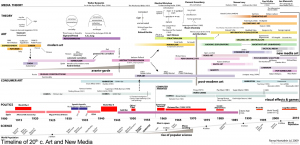
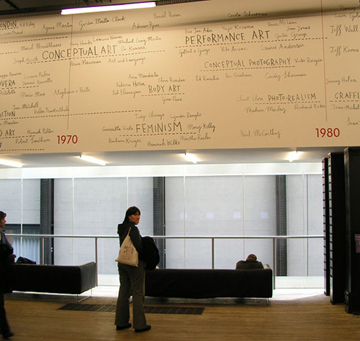
Art Timelines (1960 – present) movements, events and artists
Referred to as the ‘age of pluralism’, late 20th-century art includes: performance art, as demonstrated by Gilbert and George and Joseph Beuys; op art, such as the work of Bridget Riley; Photorealism (Richard Estes, among others); Land art, including Robert Smithson's earthworks and Christo's ‘packages’ (wrappings of buildings); political art, such as the paintings of Leon Golub; Installation art (an arrangement of materials to fit a specific space), such as the work of Richard Wilson; and the birth of ‘feminist’ art, led by Judy Chicago and Miriam Schapiro.
Staged photography, as in the work of Cindy Sherman; mixed media art (that of Judy Pfaff and many others); and video art, such as the work of Nam June Paik and Gillian Wearing, reflect the technological advances of the era, and dominate the last 20 years of the century. Individual artists, rather than art movements, characterize the last ten years; artists who have achieved notoriety include Damien Hirst (for his bisected and pickled animal parts), Chris Ofili (for his paintings incorporating elephant dung), Tracey Emin (for her ‘lived in’ bed submitted for the 1999 Turner Prize), and Martin Creed (for his Turner prizewinning Light Going On and Off (2001; Tate Britain)).
LINKS
http://encyclopedia.farlex.com/20th-century+art
http://en.wikipedia.org/wiki/Modern_art
http://wwar.com/artists/
http://arthistory.about.com/library/outlines/blmodern.htm
http://www.visual-arts-cork.com/contemporary-art.htm
Your own art practice in a historical and critical context
Start with a formal description of what you see/hear/expereince ie how you are reading the work.
• Subject matter - What is an image/sound of?
• Materials - What is it made of?
• Dimensions - How big/small is it?
• Aesthetic - What colours, shapes, textures are involved?
Then ask what is the significance of your creative project using the following 5 critcial and analytical approaches :
• Historical perspective (when, where and how did it happen?)
• Cultural perspective (what does it mean? values and beliefs)
• Social perspective (how is it used/who uses it?)
• Political perspective (what is it's role in terms of power?)
• Aesthetic perspective (design aspects- how and why is it designed this way?)
See A guide to critically analysing art works for more details.enter
Links
The Fundamentals of Critical Reading and Effective Writing
http://www.criticalreading.com/interpretation.htm
10 Writing Tips from the Masters
http://www.pickthebrain.com/blog/art-of-writing/
STRATEGIES FOR LOOKING AT, TALKING and WRITING ABOUT ART
http://www.ccds.charlotte.nc.us/green/looking_and_writing_about_art.htm
A Practical Guide to Writing About Art
http://pages.towson.edu/sisaacs/creq.htm
|Writing the Art History paper
http://www.dartmouth.edu/~writing/materials/student/humanities/arthistory.shtml
Learning the Art of Critical Thinking
http://www.criticalthinking.org/articles/becoming-a-critic.cfm
Links
Damien Hirst http://www.artchive.com/artchive/H/hirst.html
Valerie Export http://www.valieexport.org/
Jeff Koons http://www.jeffkoons.com/